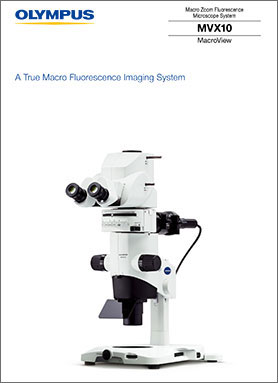
Reseach Macro Zoom System Microscope MVX10 : Features (1)
- High fluorescence efficiency plus stereo observation
- Seeing is believing: tailor-made system solutions from Olympus
Bright fluorescence imaging with seamless macro to micro zooming.
High fluorescence efficiency plus stereo observation
Up until now, stereo microscopes have been the instruments of choice for fluorescence observation at low magnifications. For the stereoscopic effect, two optical paths are used — one for the left and one for the right eye. Stereo microscopy though, is not very well suited to imaging the weak light generated by fluorescence, since the light collected by the objective is split in two. The Olympus MVX10 MacroView on the other hand, employs a single-zoom optical path with a large diameter, which is optimized to collect light with unprecedented efficiency and resolution at all magnifications. From fluorescent observation of whole organisms such as zebrafish at low magnification to the detailed observation of gene expression at the cellular level at high magnification — the MVX10 helps you to see it all.
What's more, the MVX10 features a unique pupil division mechanism in the light-path to mimic the effect of stereo microscopy. So you can get the best of both worlds — high light efficiency and stereo observation — in one system just by moving a slider. This puts the MVX10 in a class of its own.
![]() |
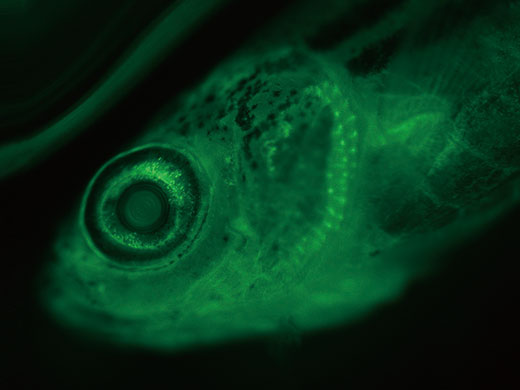
Zebrafish spinal cord expressing green fluorescent protein |
![]() |
Reflected light fluorescence unit + fluorescence mirror unit |
Dedicated to fluorescence
All components of the light path contribute to the phenomenal fluorescence
performance of the MVX10. Using the latest technologies and new materials,
the MVX10 objectives produce almost zero autofluorescence. Together with
very high numerical apertures this results in an extremely good signal-to-noise
(S/N) ratio, ensuring excellent contrast for observation of even the faintest
fluorescence signals. Moreover, the S/N ratio is further enhanced by two
novel proprietary features:
- A new coating technique gives the Olympus HQ filters an exceptional edge steepness and very low autofluorescence.
- All the filter cubes are equipped to absorb stray light.
Light collection efficiency is also maximized with an aspherical fluorescence collector, which bundles the light for minimum intensity loss.
Smooth and Parfocal objectives for seamless observation from macro to micro

A unique objective line
The MVX10 provides the same working distance and large field of view
as stereo microscopes, but with much higher resolution due to the
increased numerical aperture (NA). Specially designed for the MVX10,
the 0.63x, 1x and 2x planapochromatic objectives produce the highest
image quality. All three objectives are pupil-corrected for best image
flatness and show high transmission to NIR and superior chromatic
aberration correction. This produces great flexibility for efficient, fast and
precise fluorescence observation, screening and imaging — from low to
high magnification over time.
Dynamic
The 0.63x objective has a maximum field of view of 55 mm, making it
easy to track fast-moving specimens over time. With its exceptionally
high NA of 0.15, fluorescence from large objects, such as whole
embryos, can be viewed with perfect brightness at all magnifications.
Gentle
The peerless NA and S/N ratio values of all the optical components mean that
specimens can be exposed to fluorescent light for shorter periods. This
is also true at near-infrared wavelengths where the MVX10 has superior
transmission properties and thus fluorochromes throughout the entire spectrum
can be used with minimal sample damage.
From macro to micro
Using the 2-position revolving nosepiece with the 0.63x and 2x objectives
expands the usable zoom range up to 31. The objectives are parfocal corrected,
making refocusing after objective switching very quick and easy. Only a
small amount of fine focusing is necessary to return to the optimal focus
position, making macro to micro changes seamless. The 2x objective is also
equipped with an additional correction collar to adjust the image quality
independently of the specimen medium.
Long working distance (WD) ensures more efficiency in screening
and observation
In comparison with stereomicroscopes, the MVX 10 provides the same working
distance and a much higher NA (65mm WD and maximum 0.25 NA when using a
1x objective). This makes fluorescence screening and verification of gene
expression especially efficient, improves speed and precision, reduces
judgment errors, and eliminates the need to switch back and forth between
a stereomicroscope and inverted microscope.